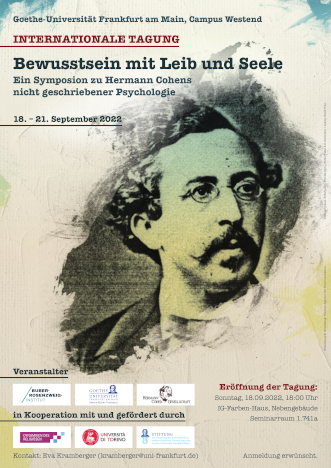
 Internationale Tagung
Bewusstsein mit Leib und Seele.
Internationale Tagung
Bewusstsein mit Leib und Seele.
Ein Symposion zu Cohens nicht geschriebener Psychologie
18.-21.09. 2022
Goethe-Universität Frankfurt am Main, Campus Westend
 Veranstalter
Buber-Rosenzweig-Institut für jüdische Geistes- und Kulturgeschichte der Moderne und Gegenwart an der Goethe-Universität Frankfurt a.M. / Hermann-Cohen-Gesellschaft
in Kooperation mit dem Forschungsschwerpunkt „Dynamiken des Religiösen“ an der Goethe-Universität Frankfurt und dem Dipartimento di Filosofia e Scienze dell’Educazione an der Università degli Studi di Torino
Sonntag, 18.09.2022
Eröffnung der Tagung (NG. 1.741a)
18:00 Grußworte und Einführung
Christian Wiese (Präsident der Hermann-Cohen-Gesellschaft, Goethe-Universität Frankfurt)
David Käbisch (Dekan des Fachbereichs Evangelische Theologie, Goethe-Universität Frankfurt)
Hans Martin Dober (Universität Tübingen)
18:15-19:30
Eröffnungsvortrag
Chair: Hans Martin Dober (Universität Tübingen)
Jörg Dierken (Martin-Luther-Universität Halle-Wittenberg): Leben – Subjektivität – Sozialität. Probleme und Perspektiven des Begriffs der Seele im Zeitalter seiner Verflüchtigung
19:30 Empfang
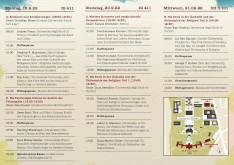
Montag, 19.9.2022 (IG 411)
09:00-12:30
A. Kontexte und Annäherung an die Fragestellung
Chair: Christian Wiese (Goethe-Universität Frankfurt a.M.)
09:00-10:00
Andrea Poma (Università degli Studi di Torino): Freiheit und Psychologie bei Kant und Cohen
10:00-10:30 Kaffeepause
10:30-11:30
Gregory B. Moynahan (Bard College, New York): „…das sittliche Programm der neuen Zeit und aller Zukunft der Weltgeschichte“: Mögliche Verbindungen zwischen Cohens Rechtsethik und Psychologie im historischen Kontext
11:30-12:30
Roy Amir (The Hebrew University Jerusalem): The Pure Will as the Ground of Psychology in Cohen’s System
12:00-15:00 Uhr: Mittagspause (Mensa der Universität)
15:00-18:30
B. Die Psychologie Cohens im System der Philosophie
Chair: Inka Sauter (Goethe-Universität Frankfurt)
15:00-16:00
Geert Edel (Wyk auf Föhr): Cohens Kritik der Psychologie in der Erkenntnistheorie
16:00-16:30 Kaffeepause
16:30-17:30
Hartwig Wiedebach (Göppingen): Hermann Cohens Aufbau des Bewusstseins
17:30-18:30
Kurt Walter Zeidler (Universität Wien): Zwischen Begründungs- und Abschlussreflexion: Die Psychologie im System Cohens
19:00
Gemeinsames Essen im Ristorante Isoletta, Feldbergstraße 31
Dienstag, 20.9.2022
09:00-12:30
C. Weitere Kontexte
Chair: Renate Schindler (Berlin)
09:00-10:00
Chiara Adorisio (Università degli Studi di Roma „La Sapienza“): Die Seele in der jüdischen Philosophie vor Cohen (Arbeitstitel)
10:00-10:30 Kaffeepause
10:30-11.30
Pierfrancesco Fiorato (Università degli Studi di Parma): Im Spannungsfeld zwischen Geist und Leben: Hermann Cohen über die Unsterblichkeit der Seele
11:30-12:30
Heinrich Assel (Universität Greifswald): Der Gegenwartsbegriff im Verhältnis zur Philosophie Cohens: Jakob Gordin
12:30-15.00 Mittagspause (Mensa der Universität)
15:00-18:30
D. Die Seele in der Ästhetik und der Philosophie der Religion (I)
Chair: Luca Bertolino (Università degli Studi di Torino)
15:00-16:00
Dietrich Korsch (Kassel): Reines Gefühl und Religion
Anmerkungen zum Gefühlsbegriff bei Hermann Cohen und Friedrich Schleiermacher
16:00-16:30 Kaffeepause
16:30-17:30
Asher D. Biemann (University of Virginia): Die Gestalt der Seele und das Urbild des Menschen: Anmerkungen zu Hermann Cohens Ästhetik
17:30-18:30
Hans Martin Dober (Universität Tübingen): Die Musik als Metapher des Seelenlebens
Mittwoch, 21.09.2022 (Seminarhaus SH 3.101)
09:00-12:30
E. Die Seele in der Ästhetik und der Philosophie der Religion (II)
Chair: Ezio Gamba (Università degli Studi di Torino)
09:00-10:00
Ido Ben Harush (Yale University / Goethe-Universität Frankfurt): Götzendienst und Bilderverbot in der Ästhetik und Religionsphilosophie Cohens
09:00-10:30 Kaffeepause
10:30-11:30
George Y. Kohler (Bar Ilan University, Ramat Gan): Sünde und Vergebung als Aspekte von Cohens Seelenlehre im Spätwerk
11:30-12.15
Abschlusspanel


